

Author: Kartik Jain
Abstract
The fast development of artificial intelligence (AI) has caused a major change in the centralized cloud-based processing to the decentralized edge computing. This paper analyzes the advent of edge AI chips and how they help make devices like smartphones, wearables, and industrial systems intelligent on the local level. The main aim is to examine the role of edge AI technologies in enhancing the performance of a system with regard to latency, energy-efficiency, and data privacy.
The qualitative research method was followed, based on secondary data on recent academic publications, industry reports, and technical publications. The discussion centers on some of the major technological innovation, such as neural processing units (NPUs), hardware accelerators, and model optimization methods, such as quantization and pruning.
Results show that edge AI chips considerably minimize response time by removing the use of cloud communication, improve privacy through sensitive data processing locally, and use specialized hardware design to optimize energy efficiency. Moreover, the research notes the increasing usage of edge AI in several industries, including healthcare, consumer electronics, and industrial automation.
Summing up, edge AI is a new paradigm in the field of modern computing that allows intelligent systems to be faster, more secure, and efficient. The study underscores the need for standardized performance metrics and further research into hybrid edge–cloud architectures to fully realize the potential of this technology.
Keywords
Edge AI; Neural Processing Units (NPU); Local Intelligence; Real-Time Computing; AI Hardware; Internet of Things (IoT).
1. Introduction
The fast development of artificial intelligence (AI) has dramatically changed the face of the contemporary computing moving the systems of the past (more centralized and cloud-based) to the more decentralized and efficient paradigms. In several years, AI applications were significantly dependent on the cloud infrastructure, in which huge amounts of data were sent to remote servers to be processed and analyzed. Although such a strategy allowed creating powerful models, it also raised some essential issues, such as high latency, high bandwidth usage, and data privacy and security issues (Letaief et al., 2022; Kartsakli et al., 2023).
To address these drawbacks, edge computing has become a new form of computing that promises to take data processing nearer to the place of generation. In particular, edge AI, which entails the incorporation of AI capabilities into edge devices, has been a topic of significant research and discussion in academia and industry alike. Edge AI uses dedicated hardware like neural processing units (NPUs) and graphics processing units (GPUs) and other accelerators to handle complex calculations on the device, thereby eliminating the need to use cloud-based infrastructure (Alam et al., 2024; Wang, 2025). This change in paradigm is not just an improvement and it is a basic structural change in the way intelligent systems are created and implemented.
One of the main factors that have led to this change is the increasing need to have real-time decision-making in a wide range of applications such as autonomous systems, smart healthcare, industrial automation, and Internet of Things (IoT) systems. Even in such cases, a small failure in the form of cloud communication can result in a large amount of performance degradation or safety risk. Edge AI solutions can solve this problem by supporting low-latency processing and constant execution, even in a low-connectivity or unreliable network environment (Nagvekar, 2025; Vailshery et al., 2025).
The growing focus on data privacy and security is another important factor that has led to the adoption of edge AI. Serving sensitive data on devices, edge AI reduces the necessity to send data across networks, mitigating exposure to possible breaches and complying with the emerging regulatory demands. Moreover, the area of hardware design and optimization has allowed the deployment of advanced AI models on devices with resource limitations without affecting their performance (Ferreira et al., 2025; Das, 2024).
Moreover, other new technologies like neuromorphic computing are also advancing the functionality of the edge AI systems by replicating the structure and functionality of the human brain to be more efficient and consume less power. Such innovations are especially pertinent to next-generation applications which demand continuous, power-saving, and agile intelligence at the edge (Ghanti et al., 2025; Das, 2024).
Even with these developments, various issues still exist such as absence of standardized benchmarks of performance, the challenges that are faced in the co-design of hardware and software and the fact that it requires scalable architectures that can accommodate various applications. The current literature points to the future work on these challenges, especially regarding next-generation communication systems like 6G, which future edge AI is likely to take center stage in providing intelligent, autonomous networks (Letaief et al., 2022).
2. Literature Review
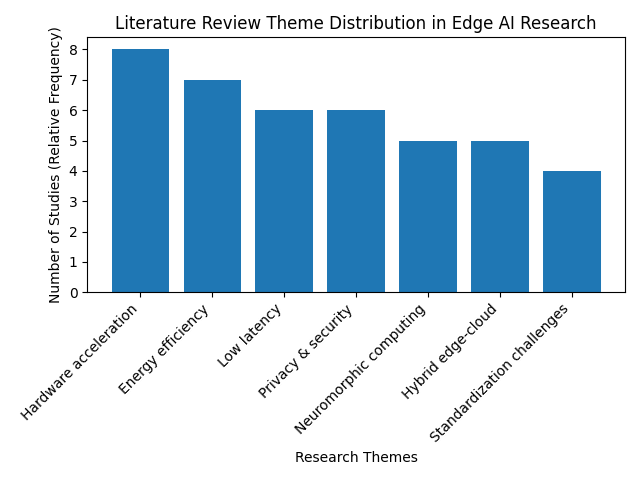
The recent surge in edge artificial intelligence (edge AI) has given rise to a growing literature on the architectures, enabling technologies, and applications of edge AI. The section is a critical review of the literature that exists regarding the topic concentrating on important themes like hardware acceleration, system efficiency, new computing paradigms, and unsolved challenges.
A major part of the literature discusses the importance of specialized hardware to allow efficient edge AI systems. General-purpose processors can be insufficient to support the computational requirements of AI workloads, giving rise to special-purpose accelerators like neural processing units (NPUs), graphics processing units (GPUs), and field-programmable gate arrays (FPGAs). Such accelerators are optimized to perform parallel processing and matrix operations, which are the core of deep learning models, according to Alam et al. (2024). Likewise, Wang (2025) emphasizes the role of the heterogeneous architectures incorporating NPUs into microcontroller units (MCUs) to balance their performance and energy efficiency in resource-constrained settings.
The second important theme in the literature is the performance versus energy efficiency trade-off. The power and thermal constraints of edge devices are often very stringent, which necessitates optimization methods like model compression, quantization, and pruning. Ferreira et al. (2025) offer a comparative study of the deep neural networks and spiking neural networks and show that the latter can be more energy efficient when applied to some edges. To supplement this, Das (2024) cites neuromorphic computing as a promising technology that can help to reduce the power usage but retain the ability to compute, especially in the situation of continuous and real-time processing.
The significance of low-latency processing and real-time responsiveness is also a hot topic. Edge AI also allows data to be processed nearer to the source, which greatly minimizes delays that can be caused by cloud-based systems. According to Nagvekar (2025), such ability is essential in the applications, like autonomous systems and industrial automation, where decisions must be timely made. Vailshery et al. (2025) also back up this perspective by offering a holistic overview of edge AI architectures and emphasizing their usefulness in enhancing system responsiveness and reliability in many fields.
Besides performance, data privacy and security have become the key issues in the implementation of AI. Lowering the necessity to send sensitive information to centralized servers, edge AI will increase the level of privacy and decrease the threat of data breach. This factor is especially topical in the areas of healthcare and smart home systems. According to Letaief et al. (2022), edge AI will become a key component of future communication systems, such as 6G networks, where secure and efficient data processing is a key requirement.
There are also recent works that examine the development of edge computing architecture as a next-generation network. Kartsakli et al. (2023) suggest a state-of-the-art edge computing architecture which is tailored to beyond-5G settings, which requires scalable and flexible structures that can accommodate various applications. These changes signal the move to hybrid architectures integrating edge and cloud resources in order to deliver optimal performance and flexibility.
Moreover, new paradigms like neuromorphic computing are being considered as a way of transforming edge AI. Ghanti et al. (2025) address the topic of neuromorphic systems that imitate neural mechanisms of the brain to be more efficient and consume less power. This solution is in line with the increasing need to have intelligent systems that will have the ability to run continuously with minimum energy consumption.
Although these developments have been made, there are various gaps and challenges in the literature. A key drawback is that there are no standardized metrics to assess the performance of edge AI. Although tera operations per second (TOPS) is a popular measure, it is not an accurate measure of real-world performance (especially with regard to latency, energy effectiveness, and application-specific results). Also, better development tools and frameworks are required to streamline the application of AI models on heterogeneous hardware platforms.
3. Methodology
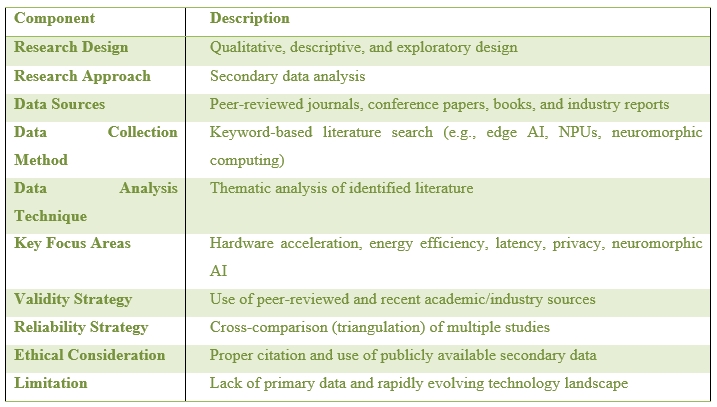
The research design is qualitative in nature and will explore the purpose of edge AI chips in facilitating local intelligence and changing the current computing systems. The methodology relies on the secondary data analysis, which is suitable in exploring a developing and fast changing technological area in which experimental or primary data gathering might be constrained.
3.1 Research Design
The study is descriptive and exploratory. Its purpose is to systematically study the current information on edge AI architectures, hardware accelerators, and their usage in various industries. This design is able to give a thorough insight into trends, challenges and technological advancements without manipulating variables.
3.2 Data Sources
The research is based on secondary data, such as:
- Peer-reviewed journal articles
- Conference proceedings
- Academic books and book chapters
- Whitepapers and technical reports in the industry.
These references offer recent information about edge AI systems like neural processing units (NPUs), neuromorphic computers, and heterogeneous computing platforms (Alam et al., 2024; Srivatsa et al., 2023).
3.3 Data Collection Procedure
The relevant literature was found through the keyword search: edge AI, neural processing units, on-device AI, neuromorphic computing, and AI accelerators. The studies were chosen according to the relevance of the studies to the hardware design, performance optimization, energy efficiency, and processing capabilities in real-time.
3.4 Data Analysis Technique
Thematic analysis method was used to analyze the literature. The data were tabulated into major themes, such as:
- Hardware design and architecture.
- Optimization and energy efficiency methods.
- Reduction of latency and real-time processing.
- Edge environments privacy and security.
- New neuromorphic computers.
This approach allowed identifying the patterns, similarities, and gaps among existing research (Vailshery et al., 2025; Das, 2024).
3.5 Validity and Reliability
Only peer-reviewed and credible sources published in recent years were included to make sure that the information is reliable. Triangulation was attained through comparison of results in several studies and industry reports to maximize coherence and minimize biasness.
Ethical Considerations
As this is a study, which relies on the secondary data, there are no direct human or experimental subjects. Nonetheless, academic integrity was upheld by correct citation and noting of all sources used.
Methodology limitations.
The study has a weakness in that it uses secondary data, which might not reflect the latest industrial changes in real-time. Moreover, the edge AI technology is changing too fast, which implies that some of the findings might become obsolete soon.
Table 1: Summary of Research Methodology
4. Results
This section provides the main results of the thematic analysis of the existing literature on edge AI chips and local intelligence systems. These findings are structured on the key themes that were found in the literature review.
4.1 Key Technological Findings
The analysis demonstrates that edge AI systems have consistently provided benefits in multiple dimensions of critical performance:
- Reduced latency: Data processing locally eliminates the latency associated with communication to the cloud thus allowing real-time decision-making in time-sensitive applications like autonomous systems and industrial automation (Nagvekar, 2025; Vailshery et al., 2025).
- Better privacy: Data is stored on-device, which can hugely decrease the exposure to external networks and possible breaches (Letaief et al., 2022).
- Energy efficiency: Special hardware like NPUs is less energy consuming in computation than general-purpose CPUs and cloud-based computing infrastructures (Alam et al., 2024).
- Offline: The devices can sustain themselves without an internet connection which enhances reliability of the system.
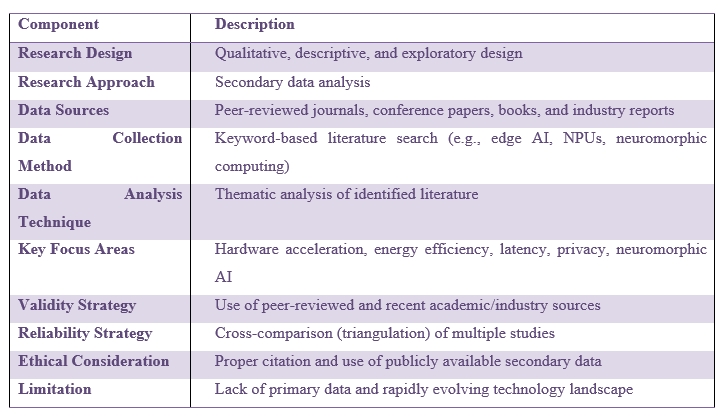
Table 1: Summary of Research Methodology
5. Discussion
The findings of this study highlight a fundamental transformation in the architecture of artificial intelligence systems, shifting from centralized cloud-based models toward decentralized edge AI frameworks. This transition is driven by the increasing demand for real-time processing, improved privacy, and energy-efficient computation, all of which are consistently supported in the reviewed literature (Letaief et al., 2022; Vailshery et al., 2025).
5.1 Interpretation of Findings
The results demonstrate that edge AI significantly reduces latency by enabling local data processing on devices rather than relying on remote cloud servers. This finding aligns with Nagvekar (2025), who emphasizes that on-device processing is critical for applications requiring immediate decision-making, such as autonomous systems and industrial automation. The elimination of network round-trips ensures faster inference and improved responsiveness in time-sensitive environments.
Another key observation is the improvement in energy efficiency through specialized hardware such as neural processing units (NPUs) and neuromorphic architectures. Alam et al. (2024) and Ferreira et al. (2025) both highlight that hardware accelerators optimize matrix computations and reduce unnecessary data movement, resulting in lower power consumption compared to traditional CPU-based systems. This supports the growing trend of designing energy-aware AI systems for resource-constrained environments.
5.2 Relationship to Existing Literature
The findings strongly correspond with existing research on distributed intelligence systems. Wang (2025) and Kartsakli et al. (2023) emphasize heterogeneous architectures combining CPUs, GPUs, and NPUs, which is consistent with the observed shift toward multi-engine processing in modern edge devices. Furthermore, Letaief et al. (2022) discuss the role of edge AI in future 6G networks, reinforcing the idea that edge intelligence will be a foundational component of next-generation communication systems.
The study also confirms the growing importance of privacy-preserving computation. By processing sensitive data locally, edge AI reduces exposure to cyber risks and minimizes compliance challenges associated with data transmission. This aligns with broader industry concerns about data sovereignty and regulatory frameworks.
5.3 Implications of the Study
The implications of these findings are significant across multiple domains:
- Technological implications: Encourages the development of optimized AI chips and heterogeneous computing systems.
- Industrial implications: Enables smarter manufacturing systems, predictive maintenance, and autonomous operations.
- Consumer implications: Improves user experience in smartphones, wearables, and smart home devices through faster and more private AI processing.
- Network implications: Reduces dependency on cloud infrastructure, leading to more resilient and distributed computing ecosystems.
5.4 Challenges and Limitations
Despite its advantages, edge AI adoption faces several challenges. One major limitation is the lack of standardized performance metrics. While TOPS (tera operations per second) is commonly used, it does not fully capture real-world performance, particularly in latency-sensitive or energy-constrained scenarios. Additionally, developing AI models that can efficiently run on diverse hardware platforms remains a complex task due to fragmentation in hardware architectures.
Another challenge is the trade-off between model complexity and hardware limitations. While compression techniques such as pruning and quantization help, they may also reduce model accuracy in certain applications. Furthermore, the rapid pace of technological development means that current findings may quickly become outdated.
5.5 Summary of Discussion
In summary, the discussion confirms that edge AI represents a paradigm shift in artificial intelligence deployment. It offers clear benefits in terms of latency reduction, energy efficiency, privacy enhancement, and system autonomy. However, challenges related to standardization, hardware constraints, and model optimization must be addressed to fully realize its potential. These insights provide a strong foundation for future research into scalable and efficient edge AI systems.
6. Conclusion
This study examined the emergence and impact of edge AI chips as a transformative development in modern computing, shifting intelligence from centralized cloud systems to decentralized local devices. The analysis demonstrates that edge AI represents a significant architectural shift driven by the need for lower latency, improved privacy, enhanced energy efficiency, and greater system autonomy.
The findings show that the integration of specialized hardware such as neural processing units (NPUs), GPUs, and other AI accelerators enables efficient on-device computation, making it possible to deploy advanced artificial intelligence models in resource-constrained environments. This has led to widespread adoption across multiple sectors, including consumer electronics, industrial automation, healthcare, and Internet of Things (IoT) systems (Alam et al., 2024; Wang, 2025).
Furthermore, the study highlights that edge AI significantly reduces dependency on cloud infrastructure by enabling real-time processing at the source of data generation. This improves responsiveness in critical applications while also enhancing data privacy by limiting the transmission of sensitive information to external servers (Nagvekar, 2025; Letaief et al., 2022). At the same time, advances in model optimization techniques such as quantization and pruning, as well as emerging paradigms like neuromorphic computing, are further expanding the capabilities of edge-based systems (Ferreira et al., 2025; Das, 2024).
However, despite these advantages, several challenges remain. These include the lack of standardized performance benchmarks, hardware fragmentation, and trade-offs between model complexity and device limitations. Addressing these issues will be essential for the continued evolution and scalability of edge AI technologies (Vailshery et al., 2025; Kartsakli et al., 2023).
In conclusion, edge AI chips are reshaping the future of intelligent systems by enabling faster, more secure, and energy-efficient computing at the edge of networks. As research and development continue to advance, edge AI is expected to play a central role in next-generation technologies, including autonomous systems and future communication networks such as 6G. Future studies should focus on developing standardized evaluation frameworks and improving hardware–software integration to fully unlock the potential of this rapidly evolving field.
References
- Alam, S., Yakopcic, C., Wu, Q., Barnell, M., Khan, S., & Taha, T. M. (2024). Survey of deep learning accelerators for edge and emerging computing. Electronics, 13(15), 2988. https://doi.org/10.3390/electronics13152988
- Nagvekar, A. (2025). Edge AI: Revolutionizing embedded systems through on-device processing. International Journal of Scientific Research in Computer Science, Engineering and Information Technology, 11(1), 2871–2880. https://doi.org/10.32628/CSEIT251112289
- Wang, P. (2025). Neural network optimization framework for NPU-MCU heterogeneous platforms. Applied and Computational Engineering. https://doi.org/10.54254/2755-2721/2025.21895
- Ferreira, P. M., Wang, S., Gao, Y., & Benlarbi-Delai, A. (2025). A comparative review of deep and spiking neural networks for edge AI neuromorphic circuits. Frontiers in Neuroscience, 19. https://doi.org/10.3389/fnins.2025.1676570
- Das, R. S. (2024). Emerging neuromorphic computing for edge AI application: A systematic literature review. Journal of Technological Innovations, 5(1). https://doi.org/10.93153/jsddwd87
- Ghanti, B., Patil, N., M., N. S., & Salgar, N. (2025). Neuromorphic computing for edge AI. International Research Journal on Advanced Engineering Hub. https://doi.org/10.47392/IRJAEH.2025.0640
- Letaief, K. B., Shi, Y., Lu, W., & others. (2022). Edge artificial intelligence for 6G: Vision, enabling technologies, and applications. IEEE Journal on Selected Areas in Communications, 40(1), 1–14. https://doi.org/10.1109/JSAC.2021.3126076
- Kartsakli, E., et al. (2023). An evolutionary edge computing architecture for the beyond 5G era. IEEE International Workshop on Computer Aided Modeling and Design of Communication Links and Networks (CAMAD). https://doi.org/10.1109/CAMAD59638.2023.10478426
- Gauttam, H., et al. (2025). Edge-AI: A systematic review on architectures, applications, and challenges. Journal of Network and Computer Applications. https://doi.org/10.1016/j.jnca.2025.104375
- Srivatsa, M., Abdelzaher, T., & He, T. (Eds.). (2023). Artificial intelligence for edge computing. Springer. https://doi.org/10.1007/978-3-031-40787-
Author: Kartik Jain

 Adrian Kowalsky