
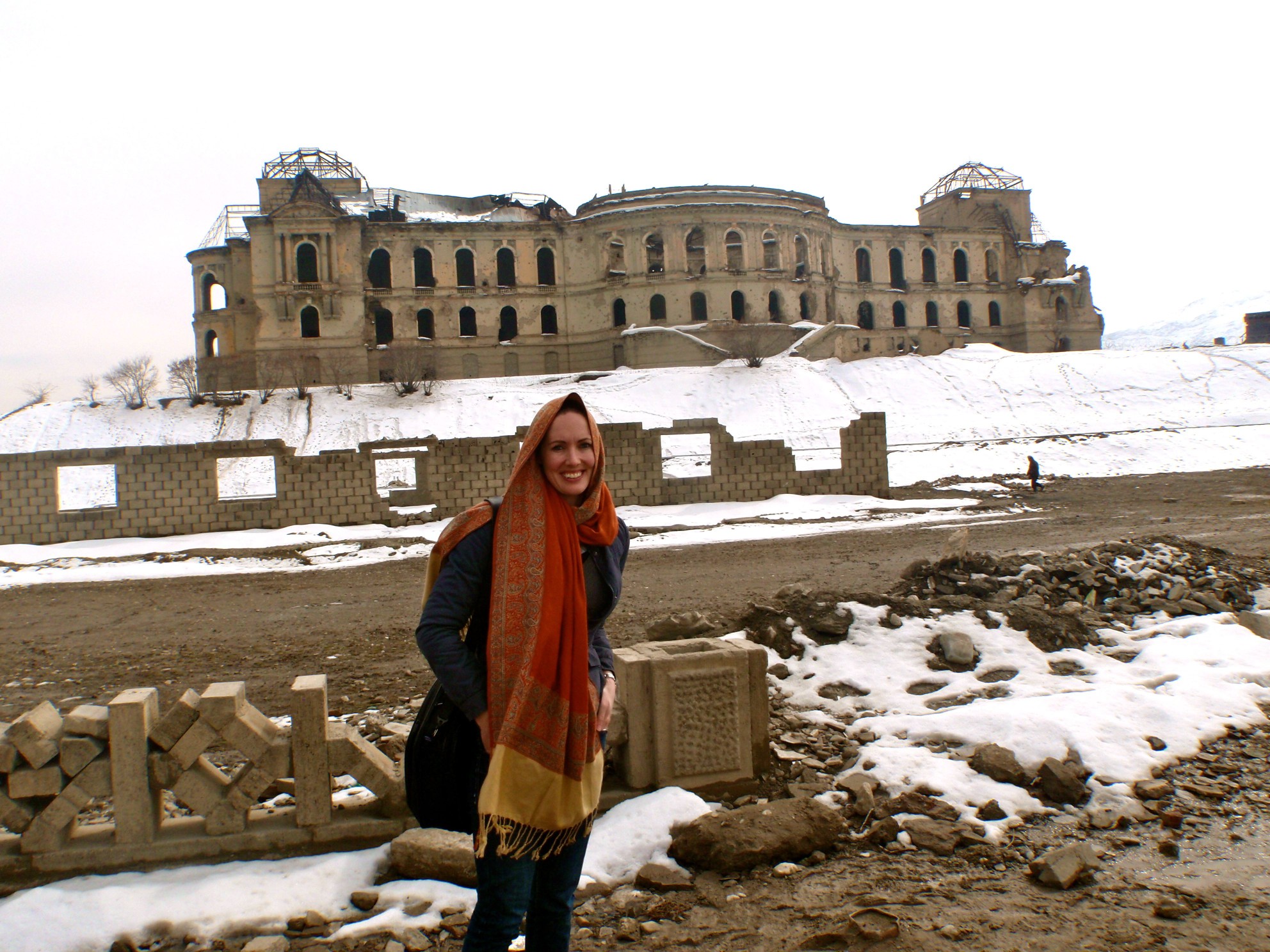
Over the past two decades, Renee Le Cussan has worked with governments, UN agencies and international organisations across Africa, Asia, the Middle East and the Pacific on projects spanning international development, governance, migration & border management, institutional strengthening and social impact. We spoke with her about the experiences that changed the way she thinks about leadership, public institutions and decision-making.
Interviewer: Looking back over the last twenty years, you’ve worked with governments, UN agencies and international organisations across many countries. Your projects have ranged from researching the heroin trade in Afghanistan and Pakistan, to institutional capacity building in Sri Lanka. Was there ever a career plan?
Renee Le Cussan: (Laughs.) Yes and No. I was always interested in geopolitics and international development, and loved to travel as much as possible.
At the time I wasn’t consciously building a career around a particular theme. One year I’d be working on security analysis or border management, the next on governance, then helping assess social impacts or supporting institutional strengthening in a completely different region.
But, when I look back now, there is a common thread. Although the projects were all different, they were really focused on the same concept – how do you help organisations understand complex issues and navigate difficult decisions?
Sometimes that’s about improving systems. Sometimes it’s about providing the research and evidence to help leaders think through difficult choices and policies. Sometimes it’s simply about listening to the people who understand the problem and environment better than anyone else, and ensuring their voices are heard.
Interviewer: Is there a particular experience that shaped the way you view leadership and public institutions?
Renee Le Cussan: Afghanistan and Pakistan changed me quite a bit.
I was still fairly early in my career when we were working on a capacity-building programme with a Pakistani law enforcement agency responsible for border management along the Afghanistan–Pakistan border.
We’d developed a really good relationship with one of the senior commanders. He was experienced and genuinely committed to improving the organisation he led. We spent a lot of time talking about leadership, reform and planning for the future of the organisation.
About a week after one of our visits he was targeted and killed in a suicide bombing.
Hearing that news stopped me in my tracks. It brought home the immense personal cost borne by the people working within these institutions every day.
For me, it cemented the human element within institutions. Institutions are just groups of people trying to do extraordinarily difficult jobs under severe pressure, and often at enormous personal risk.
I think that’s when I stopped seeing governance as being primarily about policies, strategies and org charts. It became much more about supporting good people to make good decisions in environments that are rarely predictable.
Interviewer: Did that experience change the way you approached later projects?
Renee Le Cussan: Absolutely, it made me much more pragmatic and focused on real-world application.
When you’re sitting in Canberra, London or Washington it’s easy to design a governance framework that makes perfect sense on paper. Then you arrive somewhere completely different and realise that reality doesn’t always fit the framework.
When you’re running programs across Asia, Africa, or the Pacific, you constantly encounter tension between standard institutional controls and operational reality. For example, clients rightly require strict financial accountability. But when you’re working in remote or fragile areas, paper receipts simply don’t exist, cash is the only currency, and there are no registered vendors. Often there isn’t even reliable electricity.
Nobody was being unreasonable. The client was trying to protect public money. We were trying to deliver a programme in the real world.
Eventually the conversation stopped being about receipts and became about accountability. If a receipt wasn’t possible, what other evidence could demonstrate that funds had been used appropriately?
Looking back, I probably had that conversation in one form or another dozens of times.
It’s why I’ve become much more interested in the purpose behind a governance process, and being realistic about how it is applied to the operating environment, rather than whether every step is followed exactly as written.
Interviewer: You’ve also worked on programmes involving international sanctions. Was that another example?
Renee Le Cussan: Yes exactly. I’ve worked on programmes involving countries under sanctions during periods when the sanctions environment was changing regularly.
People often imagine compliance as something you do at the beginning of a project. Read the rules, make sure you’re compliant and then get on with the work.
That wasn’t our experience at all.
We’d receive updated legal advice, review programme activities, discuss the implications with clients and then, a few weeks later, we’d be doing exactly the same thing again because something had changed.
It reinforced the idea for me that governance, risk and compliance isn’t static.
Often the environment changes faster than the policies do. This is where good judgement really matters.
Interviewer: You’ve used the term ‘institutional strengthening’. What does that actually mean to you?
Renee Le Cussan: I think it’s become one of those expressions that’s used so often it’s almost lost its meaning. For me it’s actually pretty simple – If our team disappeared tomorrow, could the organisation continue doing the job?
If the answer was no, then we’d probably created dependency rather than capability.
Some of the projects I’m proudest of are the ones where I hear, years later, that an agency is still using the systems we helped introduce, or that relationships we built between organisations are still working, or that local staff have taken ownership and improved what we started.
That’s incredibly satisfying because it means the work didn’t depend on us being there forever.
Interviewer: You’ve spent much of your career working in environments that most organisations would describe as high risk. Has that changed the way you think about risk?
Renee Le Cussan: I think it made me realise that risk isn’t something you can really ever fully eliminate.
Early in my career I probably thought the objective was to reduce risk wherever possible.
Over time I realised that many of the decisions we were making involved choosing between competing risks rather than removing them altogether.
If you strengthened one control, it might slow delivery. If you moved more quickly, you might increase operational exposure. If you applied every governance requirement exactly as written, you might make a project impossible to deliver in a fragile environment.
The question gradually changed from “How do we avoid risk?” to “Which risks matter most, and what are we trying to protect?”
Interviewer: As you look to the future, where do you think your experience can add the most value?
Renee Le Cussan: I still enjoy project work as much as I ever have, particularly projects that are a little different and require critical thinking.
Throughout my career I’ve been fortunate to work on everything from organised crime and irregular migration to governance reform, social impact assessments and institutional development. More recently I’ve really enjoyed work in places like Papua New Guinea and Timor-Leste, where the challenges are complex, the operating environments are unique and there isn’t a textbook solution.
Those are the kinds of projects I find most rewarding because they require curiosity, good local partnerships, adaptability and a willingness to look at problems from different perspectives.
At the same time, I’d like to continue building on the governance and institutional strengthening aspects of my career. Helping organisations become more capable, solve difficult problems, and leave something sustainable behind – this has probably been the most consistent theme running through the last twenty years, and it’s something I’d like to continue contributing to.

Tina Johnson helped bring The Marketing Folks from a-weekly newsletter to a full-fledged news site by creating a new website and branding. She continues to assist in keeping the site responsive and well organized for the readers. As a contributor to The Marketing Folks, Tara mainly covers industry new.